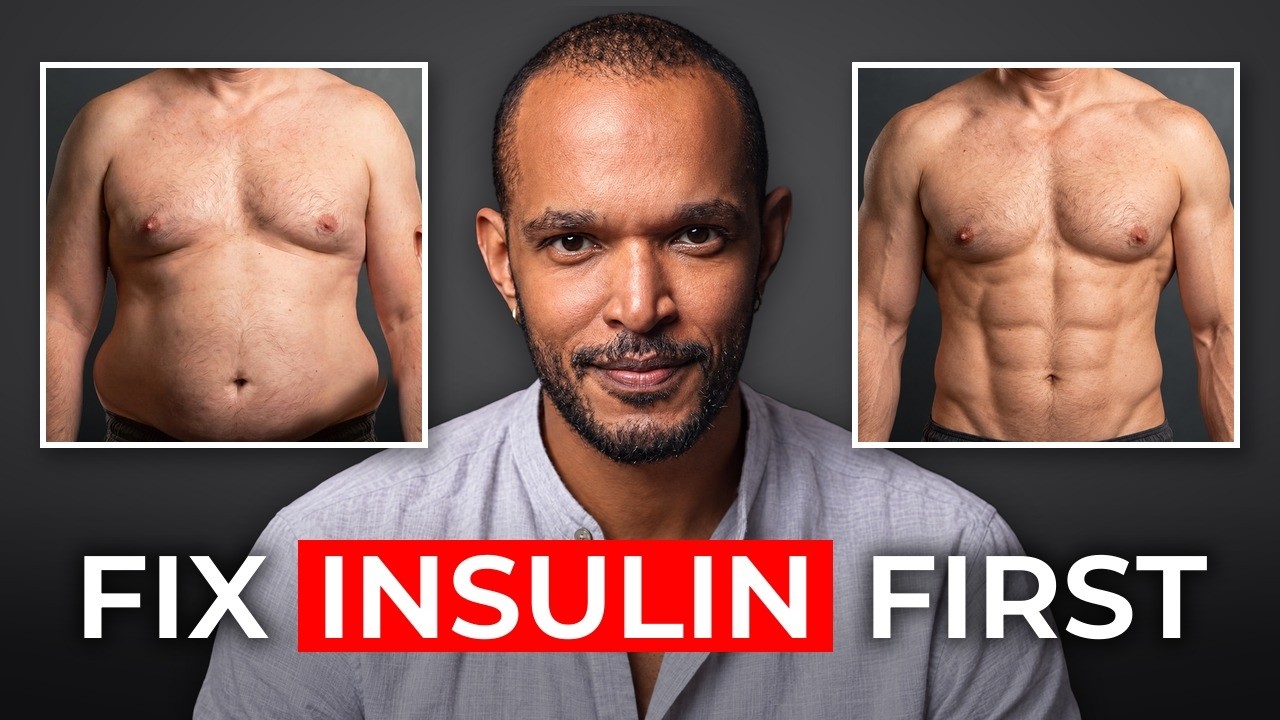
- Calories decide how much weight you lose. Insulin decides whether that weight is fat or muscle.
- In a 14-week feeding study, people with the highest insulin response lost about 1.2 kg less fat and 1.3 kg more lean mass on the same diet.
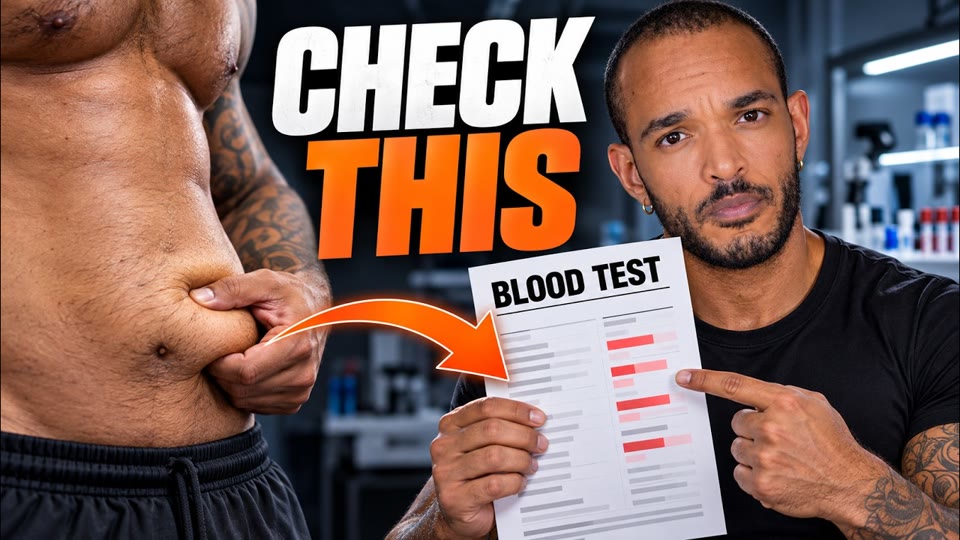
- Check four numbers: triglycerides, HDL, HbA1c and fasting insulin. Insulin goes wrong years before blood sugar does.
- Step 1: bring insulin down (packet carbs out, no big fat + big carbs meals, protein first, walk after meals).
- Step 2: send the food to your muscle (lift heavy 3 to 4 times a week, 30 to 50 g of protein 3 to 4 times a day).
Quick answer: Insulin and fat loss are linked because insulin is the storage hormone: while it's high, your fat stays locked. Calories decide how much weight you lose, but insulin decides whether that weight is fat or muscle. Bring insulin down with better carb choices, protein first and walks after meals, then send the food to muscle with heavy lifting.
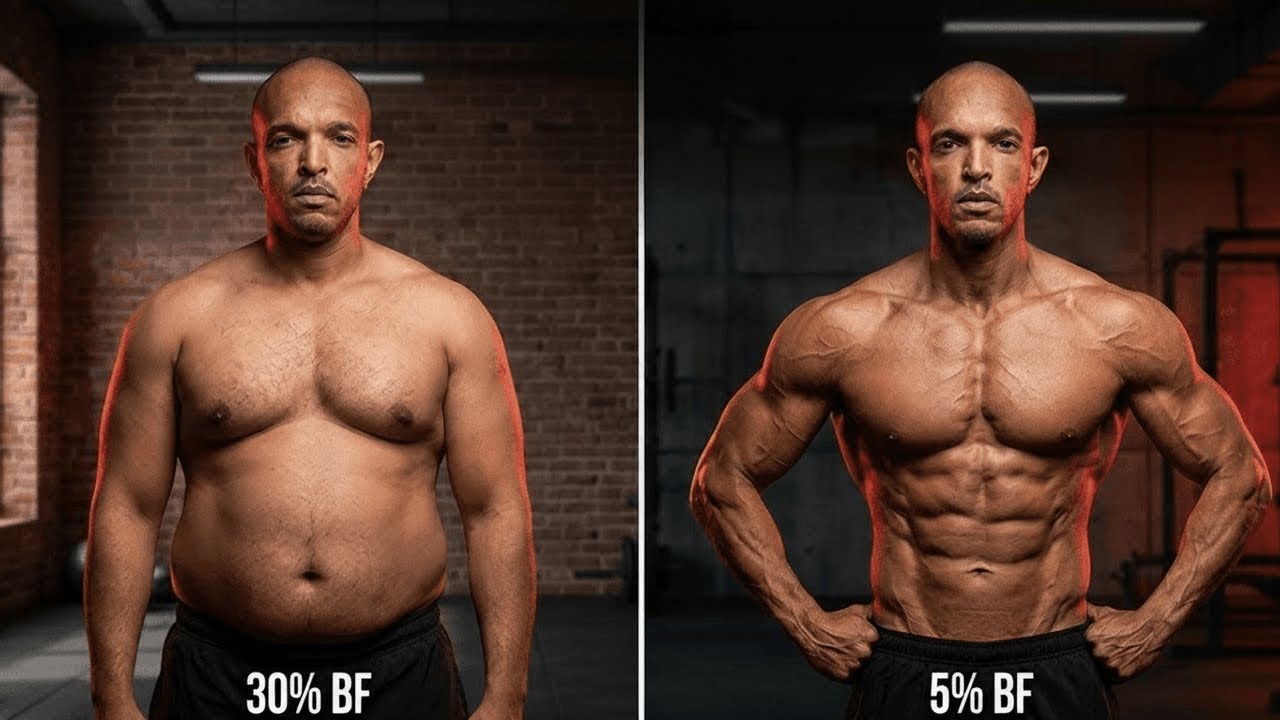
If you can't see your six-pack, you're probably over 17 or 18% body fat. And if you're over 18%, you're probably insulin resistant. Your body has stopped listening to insulin.
That's why some of you have lost 10, 15, 20 kg and still have the belly. You got smaller. You didn't get leaner. Lose weight with high insulin and you end up like a shrivelled raisin: smaller, flat, still soft.
I know because it happened to me. I was 140 kg (309 lb) at 14. I lost the weight more than once and the belly came back every single time. That's not a willpower problem. It's a hormone problem, and nobody told me what you're about to read.
What does insulin actually do with the food you eat?
Insulin decides where your food goes, into your muscle or into your fat. It's the put-it-away hormone.
Right now, all the blood in your body holds about 4 grams of sugar, one teaspoon (Wasserman, 2009). One plate of pasta has more than ten times that in carbs. So your body has to get it out of your blood fast, and insulin does it.
Here's the part most people miss. While insulin is high, your fat is locked. You basically can't burn it. That's normal after a meal. The problem starts when insulin stays high most of the day, and that's where the loop comes in.
Why does insulin resistance stop you getting lean?
Insulin resistance stops you getting lean because it keeps insulin high, and high insulin keeps fat locked while your muscle refuses the food.
So it works like a loop:
- The more fat you carry in your liver, around your organs and inside your muscles, the less your body listens to insulin.
- Your muscle stops taking the sugar in, so your body makes even more insulin.
- More insulin means the fat stays locked and more fat gets stored.
- More fat, and your body listens even less. Round it goes.
That's how a lean 25-year-old turns into a 35-year-old with a belly he can't shift. Not in a year. Slowly, one loop at a time. Age isn't the cause. It just adds to it.
It's also why bulking over 18% body fat doesn't work. You eat more to grow, but your muscle isn't listening, so the food goes to your belly. No pump, no growth. Just fat.
Can you lose fat with high insulin?
You can lose weight with high insulin, but less of it is fat and more of it is muscle. Counting calories on its own won't fix that.
And the study that shows it best: researchers fed 82 adults with a high BMI a calorie-restricted diet for about 14 weeks, with the food provided. Those with the highest insulin response lost about 1.2 kg less fat and about 1.3 kg more lean mass than those with the lowest (Wong, 2022). Same food, same plan, worse body.
So you can hit your numbers every day and still struggle. If you don't understand insulin, you don't understand fat loss. The belly side is broken down in insulin resistance and belly fat.
How do you know if insulin is your problem?
Five signs, and the more you tick, the more likely it is:
- Belly fat that won't move. For men it's usually the first place it shows up, and it sits around your organs and your liver (visceral fat).
- Months or years of eating more than you burn. Years of bulking, or years of eating clean but eating a lot.
- You sit all day. Desk, car, sofa. A muscle that doesn't work doesn't take sugar in.
- You're over 30. You put on fat slowly from 25 to 35, that fat made insulin work worse, and that made you store more fat.
- You're tired one to three hours after you eat. The classic 3pm crash. That's not your age. That's your blood sugar.
But signs are guesses. Your blood isn't.
Which blood tests show insulin resistance?
Four numbers tell you where you stand: triglycerides, HDL, HbA1c and fasting insulin. And the order matters, because insulin breaks first.
This is the part that shocked me. The Whitehall II study followed 6,538 British civil servants for about ten years. In the ones who got type 2 diabetes, insulin sensitivity dropped steeply in the five years before diagnosis, while blood sugar only shot up in the last three (Tabák, 2009). So for years, the normal test said they were fine. That's exactly why most doctors miss it.
| Test | What it shows | Where you want it |
|---|---|---|
| Triglycerides ÷ HDL | A cheap clue to insulin resistance from a normal cholesterol test | Under 1 is great, over 3 is a red flag (US units, mg/dL) |
| HbA1c (glycated haemoglobin) | Your average blood sugar over about 3 months | Under 5.7% (US) or under 42 mmol/mol (UK) |
| Fasting insulin | How hard your body is working to keep sugar down | Many doctors treat over about 10 µIU/mL as a warning sign |
The triglyceride to HDL ratio has research behind it: in 258 overweight adults at Stanford, a ratio of 3.0 or more (in mg/dL) was one of the best simple markers of insulin resistance (McLaughlin, 2003). UK and European labs report mmol/L, so the numbers come out lower: multiply your mmol/L ratio by 2.3 to compare.
For HbA1c, the American Diabetes Association calls 5.7% to 6.4% prediabetes. In the UK, NICE puts high risk at 42 to 47 mmol/mol (6.0% to 6.4%). If you want the full list I'd run, it's in blood tests for men.
What I see coaching men (and what I found in my own blood)
I was a personal trainer in London. I knew exactly what to do, and I was still getting fat. I stopped taking my shirt off in my own gym.
Then a friend told me to stop guessing and get a full blood panel. My testosterone came back at 200 ng/dL. That's low for a young man working in the fitness industry. And my HbA1c was high. The two are connected: high blood sugar goes with low testosterone. It was never a problem with my discipline. It was a problem with my blood.
So I fixed it and tracked it. I could see it moving on paper weeks before I could see it in the mirror. That's why every man we work with starts with a full blood panel reviewed by our consulting medical doctor, and we build the training, the nutrition and the supplements around it.
Two of them, from our public results: Philip came in at rock bottom at 98 kg with an HbA1c of 6.2. In under five months it was 5.4, and he got a visible six-pack. Carlos, 52, had trained for an Ironman and still sat at 97 kg with pre-diabetic bloodwork. His fasting insulin went from 11.1 to 6.4 and his HbA1c from 5.7 to 5.5, out of the pre-diabetic range.
And the good news is this moves fast. In people with type 2 diabetes on a strict 600 kcal diet, fasting blood sugar was back to normal after one week (Lim, 2011). You don't need that diet. You need two steps.
How do you bring insulin down?
That's step 1. You bring insulin down by changing which carbs you eat, how you combine them and what you do after meals. You don't need to cut all your carbs. I did keto and, like everything else, the weight came back.
What you eat, six rules:
- Cut the carbs that come in packets. Keep rice, potatoes, oats and fruit.
- Cap your carbs. Carbs in grams no higher than your weight in pounds. At 100 kg (220 lb), that's 220 g a day, maximum.
- Never lots of fat and lots of carbs in the same meal. Pizza, croissants, burger and chips. Yale researchers found fat and carbs together lit up the brain's reward areas more than either alone, and people paid more for them (DiFeliceantonio, 2018). That's why you can't stop at one slice. So a carb-heavy meal goes with lean protein, and a fat-heavy meal (eggs, avocado) goes with light carbs.
- Fats between 40 and 70 g a day. Olive oil, avocado and nuts, weighed. Not handfuls like I used to.
- Eat protein first, then vegetables, carbs last. Same food, smaller spike. Eating protein and vegetables before carbs gave a lower glucose and insulin response than the reverse order (Shukla, 2015).
- Berberine and alpha-lipoic acid with meals. They help clear the sugar from the meal. Meta-analyses link berberine (Dong, 2012) and alpha-lipoic acid (Akbari, 2018) to better blood sugar, mostly in people with diabetes. If you take medication for blood sugar, speak to your doctor first.
What you do, four rules:
- Walk 10 to 15 minutes after lunch and dinner. Your muscles pull sugar out of your blood without needing insulin. Walking 10 minutes after each meal beat one 30-minute walk a day for post-meal blood sugar (Reynolds, 2016).
- Manage alcohol. Your body burns alcohol first. After 24 g of alcohol (about two small glasses of wine), whole-body fat burning dropped by 73% in healthy men (Siler, 1999). And after that come the snacks.
- Sleep. One night of 4 hours made healthy adults about 25% less sensitive to insulin the next day (Donga, 2010).
- Stress. It tells your body to push more sugar into your blood. Most men never touch this one.
And fasting? I pushed long fasts and did one meal a day for weeks. My sleep was terrible. Fasting keeps insulin low, but low insulin is only half the job.
How do you send the food to muscle instead of your belly?
That's step 2. You send food to muscle by making the muscle work hard and feeding it protein. This is the step nobody does, and it's why the men we work with keep their results.
- Lift heavy, 3 to 4 times a week, close to failure. A working muscle pulls sugar out of the blood on its own through a transporter called GLUT4, and training raises how much GLUT4 it makes (Richter, 2013). That's how you go around insulin resistance, not through it. An empty muscle sucks the food up, so it goes there and not to your belly. Not light weights for 30 reps while you scroll: hard sets, and stronger every week.
- Protein 3 to 4 times a day, 30 to 50 g each. Every protein meal switches muscle building on for a few hours. My first meal is six eggs, four egg whites and 100 g of rice.
- A whey isolate shake within three hours of training. It's full of leucine, the part of protein that flips the muscle-building switch.
Do both steps and the loop runs backwards. Less fat, your body listens again. It listens, you need less insulin. Less insulin, the fat unlocks, you burn it, and the food feeds muscle instead of belly. If you want the boring daily habits that sit underneath this, read how to lose belly fat without starving.
What to do tomorrow
- Cut the carbs that come in packets, and cap the rest.
- Never lots of fat and lots of carbs in the same meal.
- Protein first, carbs last.
- Walk after lunch and dinner.
- Go easy on alcohol. Sleep. Manage stress.
- Lift heavy 3 to 4 days a week. Protein 3 to 4 times a day.
- Get your blood tested so you know where you stand.
I spent years fighting my own body with the wrong lever. Your blood is something you can test and change. Grab the free Fix Insulin First guide, and if you want us to read your bloods and build the plan around them, apply here.
 11:38
Fix Insulin First
What to fix before you cut a single calorie. Comment INSULIN on any of my Instagram reels and I'll send it to you.
Get it free →Frequently asked questions
How does insulin affect fat loss?
Insulin is the storage hormone. After you eat, it moves sugar out of your blood into muscle, liver or fat, and while it's high, your fat cells barely release fat. If your body has stopped listening to insulin, you make more of it, fat stays locked for longer, and when you diet more of the weight you lose comes from muscle instead of fat.
Can you lose fat with high insulin?
Yes, but less of what you lose is fat. In a controlled feeding study, adults with the highest insulin response lost about 1.2 kg less fat and 1.3 kg more lean mass than those with the lowest, on the same diet. So you still need a calorie deficit, but you also need to bring insulin down and train, or you end up smaller and still soft.
How do I know if I'm insulin resistant?
Signs are belly fat that won't move, an energy crash one to three hours after meals, years of eating more than you burn, sitting all day and being over 30. Then test it: triglycerides and HDL (divide the first by the second), HbA1c and fasting insulin. In the US, an HbA1c of 5.7% to 6.4% is prediabetes; in the UK, NICE uses 42 to 47 mmol/mol.
Do I need to cut carbs to lower insulin?
You don't need keto. Cut the carbs that come in packets and keep rice, potatoes, oats and fruit. As a ceiling, keep carbs in grams no higher than your bodyweight in pounds. Avoid meals heavy in both fat and carbs, like pizza or burger and chips, and eat protein and vegetables before the carbs on your plate.
Does lifting weights help insulin resistance?
Yes, and it's the step most men skip. A working muscle pulls sugar out of the blood through the GLUT4 transporter without needing insulin, and training increases how much GLUT4 the muscle makes. Lift heavy three to four times a week, close to failure, and get stronger every week. Light weights for 30 reps while you scroll won't do it.
Is fasting good for lowering insulin?
Fasting keeps insulin low while you do it, but low insulin is only half the job. I did long fasts and one meal a day for weeks, and my sleep was terrible. The half nobody does is sending food into muscle with heavy training and enough protein. That's what keeps the result after the diet ends.

Founder of Shapable. Sports Science and Nutrition graduate, 12 years coaching, and 140 kg at 14. His team has coached more than 1,000 men.
About Cesare →Sources (15)
- Wong JMW et al. (2022). Stimulated insulin secretion predicts changes in body composition following weight loss in adults with high BMI. J Nutr 152(3):655–662. PubMed 34587231.
- Tabák AG et al. (2009). Trajectories of glycaemia, insulin sensitivity, and insulin secretion before diagnosis of type 2 diabetes: an analysis from the Whitehall II study. Lancet 373(9682):2215–2221. PubMed 19515410.
- Wasserman DH (2009). Four grams of glucose. Am J Physiol Endocrinol Metab 296(1):E11–E21. PubMed 18840763.
- McLaughlin T et al. (2003). Use of metabolic markers to identify overweight individuals who are insulin resistant. Ann Intern Med 139(10):802–809. PubMed 14623617.
- DiFeliceantonio AG et al. (2018). Supra-additive effects of combining fat and carbohydrate on food reward. Cell Metab 28(1):33–44. PubMed 29909968.
- Shukla AP et al. (2015). Food order has a significant impact on postprandial glucose and insulin levels. Diabetes Care 38(7):e98–e99. PubMed 26106234.
- Reynolds AN et al. (2016). Advice to walk after meals is more effective for lowering postprandial glycaemia in type 2 diabetes mellitus than advice that does not specify timing. Diabetologia 59(12):2572–2578. PubMed 27747394.
- Siler SQ, Neese RA, Hellerstein MK (1999). De novo lipogenesis, lipid kinetics, and whole-body lipid balances in humans after acute alcohol consumption. Am J Clin Nutr 70(5):928–936. PubMed 10539756.
- Donga E et al. (2010). A single night of partial sleep deprivation induces insulin resistance in multiple metabolic pathways in healthy subjects. J Clin Endocrinol Metab 95(6):2963–2968. PubMed 20371664.
- Lim EL et al. (2011). Reversal of type 2 diabetes: normalisation of beta cell function in association with decreased pancreas and liver triacylglycerol. Diabetologia 54(10):2506–2514. PubMed 21656330.
- Richter EA, Hargreaves M (2013). Exercise, GLUT4, and skeletal muscle glucose uptake. Physiol Rev 93(3):993–1017. PubMed 23899560.
- Dong H et al. (2012). Berberine in the treatment of type 2 diabetes mellitus: a systemic review and meta-analysis. Evid Based Complement Alternat Med 2012:591654. PubMed 23118793.
- Akbari M et al. (2018). The effects of alpha-lipoic acid supplementation on glucose control and lipid profiles among patients with metabolic diseases: a systematic review and meta-analysis. Metabolism 87:56–69. PubMed 29990473.
- NICE (2012, updated 2017). Type 2 diabetes: prevention in people at high risk (PH38). nice.org.uk/guidance/ph38.
- American Diabetes Association. Diagnosis. diabetes.org/about-diabetes/diagnosis.
Last updated . Educational information, not medical advice. Speak to your doctor before changing medication or starting supplements, especially if you have a medical condition.